Redneck Gone Green with Yvonne Yen Liu
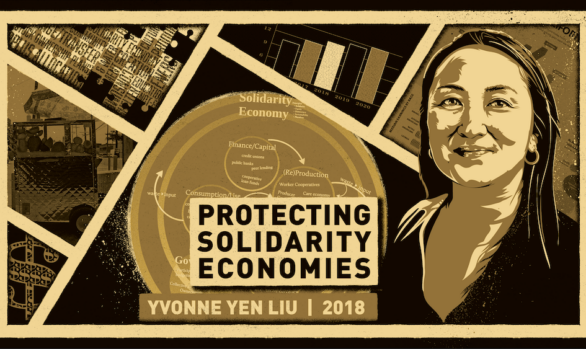
InterviewsYvonne Yen Liu: Participatory Research, Movement Infrastructure, and the Solidarity Research Center
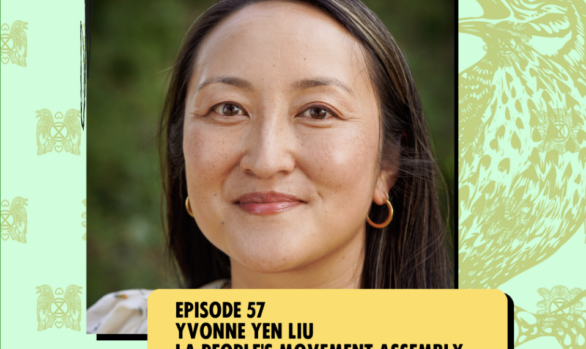
I first met Yvonne when we served on the Board of Directors of the U.S. Solidarity Economy Network (USSEN). One thing I recognized immediately was her fierce commitment to building concrete, tangible alternatives with people, not for them.
Over the years we’ve also worked together organizing Resist & Build , a movement building process that supports building the dual power of solidarity economies. Through principled struggle and disagreement, Yvonne and I have sharpened our politics and deepened our friendship—something I cherish in movement work.
Her personal journey weaves together scholarship, grassroots struggle, and community-embedded research. Born and raised in New York City to immigrant parents, she learned early what it means to navigate racialized capitalism and economic precarity. She studied cultural anthropology at Columbia University and earned a master’s in Sociology from the CUNY Graduate Center, where she pursued a PhD.
That academic training didn’t turn her into a detached expert. It gave her the language and tools to understand how power functions and to design strategies to challenge that power. She went on to co-found the Solidarity Research Center, a worker self-directed nonprofit organization that builds solidarity economy ecosystems using data science, story-based strategy, and action research. We work at the intersection of racial justice and solidarity economies.
One thing that distinguishes Yvonne’s work is her commitment to participatory research—a form of inquiry that stands in stark contrast to traditional extractive academic modes that mine communities for data. At the Solidarity Research Center, their work is co-created with workers, migrants, incarcerated people, and grassroots organizers. It’s about answering the questions that movements need to answer, not the ones funding bodies think are “publishable.”
This isn’t altruism—it’s strategy.
The work of the Solidarity Research Center has helped to support real wins. In partnership with low-wage workers and migrant farmworkers they contributed to the successful campaign for an increase in the minimum wage in Los Angeles, benefiting more than 720,000 people. They also helped decriminalize street vending, a vital informal economy for some 50,000 microbusinesses. These aren’t academic footnotes—they’re material improvements in working lives, born from movement-rooted knowledge and solidarity.
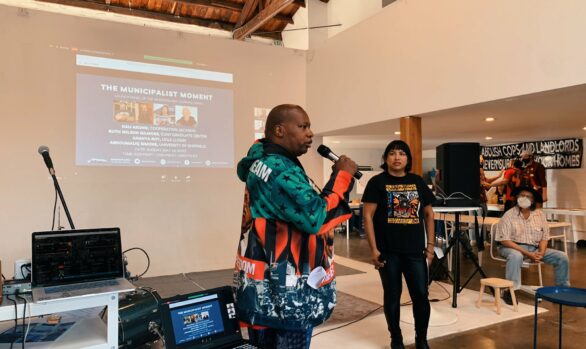
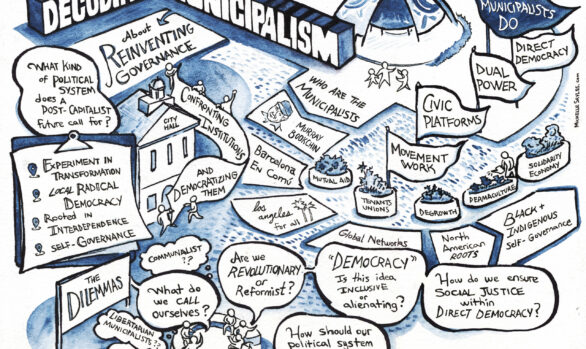
The Solidarity Research Center also organized and facilitated the Municipalist Learning Series, a public education initiative that connects municipalist theory with organizing practice. The series brings organizers, scholars, and grassroots leaders together to explore how local power can be reclaimed, how popular assemblies function, and how democratic institutions can be built from below rather than imposed from above. In an era where national politics feels increasingly hollow, municipalism offers a route toward post-capitalist practice that is both grounded and generative.
Yvonne’s work reminds us that knowledge production is not neutral—it either reinforces the structures of capital or undermines them. Participatory research and municipalist praxis sit firmly in the latter camp. They are forms of movement infrastructure as vital as worker cooperatives, community land trusts, and democratic assemblies. They help us see how ruling elites divide and conquer, how racial capitalism reproduces itself, and how we can weave our struggles together into collective power.
If we are serious about building a solidarity economy and a post-capitalist future, we need to understand that infrastructure is not just physical—it’s intellectual, relational, and strategic. Yvonne Yen Liu shows us how to build it with care, rigor, and love.